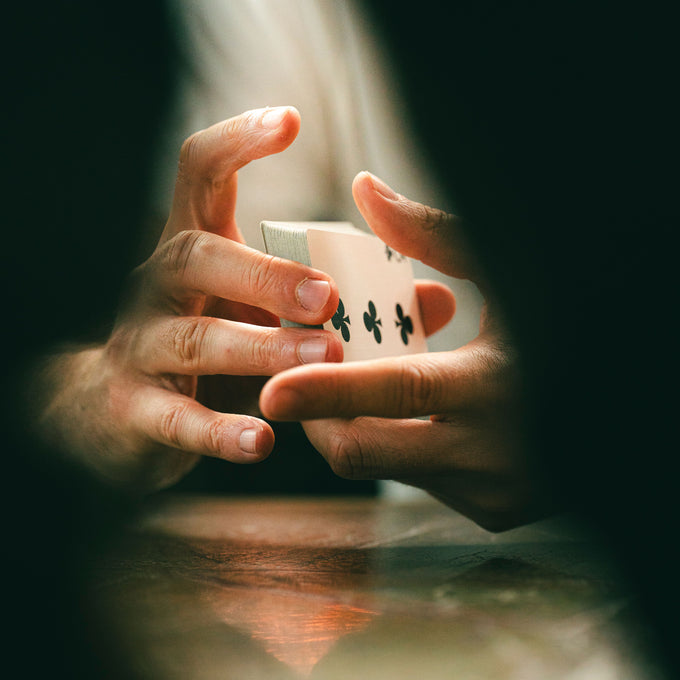

In brief
Le principe des cartes à volet apparaît au moins dès le XVIIIe siècle dans les Récréations mathématiques et physiques. Ces accessoires permettent des effets que la seule manipulation ne suffit pas à produire. Leur évolution a ajouté des systèmes élastiques pour rendre le changement visuel, puis des blocages permettant de choisir le moment du déclenchement.
In the category of gimmicks, flaps have undoubtedly made a significant contribution, allowing for the creation of new effects impossible with simple manipulations.
However, this idea of a gimmick is not new (at all)! Without claiming it as the first reference, traces of flap cards can be found at least as early as the 18th century in the Récréations mathématiques et physiques (Mathematical and Physical Recreations).

Excerpt from the plates of the Récréations mathématiques et physiques, where the ancestors of our current flap cards are depicted!
Do you enjoy this kind of anecdotal article? Visit our shop where we publish historical books on magic!
For those most interested, this same book gives us this description of flap cards with regard to the illustrations above. Discover how flap cards were talked about in the 18th century!

Over the years, this type of gaffed card has been perfected. Nowadays, there is the addition of an elastic system for a visual change, or even a locking system for advanced gimmicks that allows the gaffed card to be activated when desired. Despite this, it's interesting to see that the basic principle itself is not new!