
Escher, the "mathemagician"
Article by Sébastien Thill
Paris is hosting its first major exhibition dedicated to M.C. Escher at La Monnaie de Paris, from November 15, 2025, to March 1, 2026.
This name probably rings a bell: he's the artist who transformed geometry and mathematics into genuine optical illusions.
His stairs that ascend and descend simultaneously, his impossible shapes, his worlds where everything seems to transform before your eyes have left their mark on pop culture. From cinema ("The Name of the Rose," with its labyrinthine library, or "Inception" and its impossible stairwell), to advertising, album covers, and comics.
This artist uniquely blended art, logic, and imagination.
His unique style continues to inspire artists, scientists, and lovers of beautiful images. With over 200 works and numerous interactive experiences to immerse yourself in his optical illusions, the exhibition plunges the public into the imaginative and dizzying universe of this visionary Dutch genius, whose magical art has much to teach.

"Relativity" (1953), by M.C. Escher. THE M.C. ESCHER COMPANY/THE NETHERLANDS
Maurits Cornelius Escher, better known as M.C. Escher, was born on June 17, 1898, and died on March 27, 1972.
A Dutch artist known for his woodcuts, lithographs, and geometric patterns inspired by Islamic art.
His most famous works depict impossible constructions, explorations of infinity, tessellations, and transformations, challenging viewers' usual modes of representation.
Escher was a sickly child, placed in a special school at the age of 7. His grades were relatively low, but he excelled in drawing, a discipline in which he quickly distinguished himself.
He therefore turned to architecture and decorative arts (under the guidance of his teacher Samuel Jessurun de Mesquita, who was brutally murdered by the Nazis in 1944, but whom he never stopped thinking about).
At the end of his studies, he first traveled to Italy, a country where he discovered dizzying reliefs, steep coasts, and abrupt slopes, a contrast to the "flat country" he came from.
It was this feeling of vertigo that he would soon reproduce in many of his paintings.
Then came the discovery of Islam, where he encountered Islamic art, made of geometric patterns carved in wood or stone, or the complex art of mosaic arrangement, where pieces cleverly interlock, reversing the concepts of "empty" and "full."
These initial elements allow us to ask fundamental questions in the development of our magic:
- Who influenced your vision of magic so profoundly as to inspire its every element?
- For what reason(s) did we choose to practice the Art of Magic? (To amaze, to be amazed, to rediscover a part of childhood, or to compensate...)
- What do we seek to express by performing a magic trick?
- By what means can we express it?
Indeed, M.C. Escher's work is not limited to reproducing geometric patterns, however complex they may be, but he uses them to offer the viewer visual metaphors for abstract mathematical concepts.
Thus, symmetry/asymmetry, unity/duality, reality/reflection, universality/relativity, uniqueness/recursion, changes in size, proportion, or topological transformations are reminiscent of Winston Freer's families of effects, even revealing new families (change of size, transformation, inversion - top/bottom, front/back, above/below, order/disorder, or empty/full).
Escher quickly understood that our mind does not perceive an isolated shape; it always interprets what it observes as a figure against a background.
Thus, it becomes possible to reverse the process, making the background the figure and the figure the background, in a continuous perceptual game.
So, if our tricks are linked by narrative transitions, couldn't we consider making these transitions full-fledged acts?

"M.C. Escher, "Mosaic," 1961
Escher's canvases make us realize that our perception is dynamic: we see what our mind chooses to see.
This principle is found in works such as "Day and Night" or "Sky and Water."
From his earliest works, Escher focused on expressing space. His growing interest in mathematics and geometry was reflected in his fascination with spheres, reflective surfaces, and topological surfaces, such as the Möbius strip (an object with two sides that, if observed carefully, only has one).
On this subject, I can only encourage you to refer to the article "Crystal Ball" published on this blog.
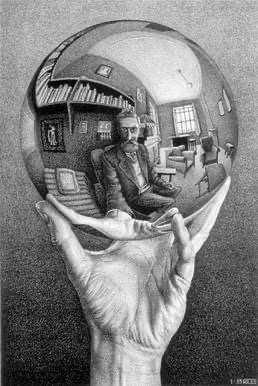
"Hand with a Reflecting Sphere," 1935, by MC Escher
You are probably familiar with the trick of the paper strip forming a ring one meter in diameter and 5 cm wide, which, when cut along its entire length, forms only one very large ring (instead of two separate rings), and which, if cut along its entire length again, this time forms two interlocked rings!)
To do this, simply give the strip a 180-degree twist before "sealing" it.

M.C. Escher, "Mobius Strip II (Red Ants)," 1963
All that remains is to cut it along its entire length, twice in a row.
Why not use mirrors, double-faced or double-backed cards, convex or concave mirrors to allow our spectators to access forms of impossible realities?
He also used many distortions and perspectives which, plausible at first glance, prove to be impossible (e.g., ascending/descending) as in his works Relativity or Belvedere, for example).
This principle is used in many grand illusions, for example, to deceive the audience, or in close-up routines, like the brilliant Gozinta Box (two boxes of the same size, one fitting into the other, and yet allowing one to fit inside the other, and worse: the "larger" one inside the "smaller" one!).
But more than anything, if Escher's works touch us so deeply, it is because they show us in a breathtaking and playful way that different realities, which are in fact just different perceptions, can coexist within the same work.
So, shouldn't we consider presenting our acts in a new light, from a different angle, under another vision?
"My work is a game... A very serious one. Only those who attempt the absurd can achieve the impossible. We love chaos because we love to reproduce order."
M.C. Escher.
11 quai de Conti - Paris 6e
Open from 10 am to 8 pm, Tuesday to Sunday. Wednesdays until 9 pm.
Prices: From €17 for adults and from €10 for children (free for children under 4)
If you enjoy the blend of magic and optical illusions, we highly recommend the work of Gérard Bakner, who presents his works in his books, in addition to dozens of explained routines!