
Gérard Bakner
Download the book "Magic with an iPhone" by clicking here.
Unprecedented
This routine uses two marketed tricks that you can combine.
AWE SUM and CUBESUM
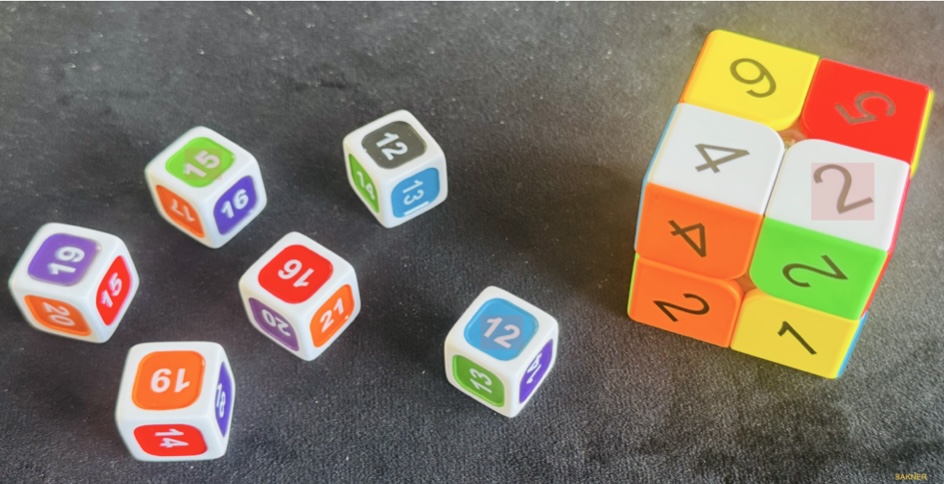
Each of these two tricks is very colorful, as if they were created to be combined into a single routine.
AWE SUM is a kind of Rubik's Cube with four numbers per side. By rotating it, you change the numbers appearing on each side and thus the total of each side. The sum of two opposite sides is twenty-eight.
We will use it not by adding the opposite sides, but by deducting the sum of the top side from twenty-eight to guess the sum of the hidden side.
Example: if you read 12 on the top side, you will deduce that the hidden (opposite) side totals: 28 - 12 = 16.
CUBESUM is a set of seven dice, each face of which has a different color and a number from 11 to 19. One of the dice is removed from the other six each time it is presented.
It will be hidden and will provide the sum of the faces of the other six dice (provided that each of these six dice has a different colored face).
Note that the sum of the six visible faces is the same as the sum of the six hidden faces.
It is the number on the green face of the unused die that will provide this total.
Example: the green face of the unused die shows the number 17. You only have to add these two digits 1 + 7 = 8 and subtract the found digit from 100, 100 - 8 = 92.
The sum of the visible (or hidden) faces of the other six dice will be 92.
That's all, and since you know this number in advance, you won't have to do anything for CUBESUM.
You will only have to perform the subtraction of 28 for AWE SUM.
PLUS:
If you want to repeat this trick, you just have to swap the die that was set aside for another one and the result will be different.
This is one of the rare tricks where it is recommended to present it two or three times.
DOUBLE CURIOSITY
SETUP
Cards with numbers.
1-2-3-4-5-6-7-8-1-9-8-8-7-6-5-4-3-2-1
ROUTINE
The magician takes out the cards from the small 19-card packet:
1-9-8
and places them face up on the table. He cuts the deck at this point.
The two halves of the deck are riffle shuffled by one of the two spectators. This spectator takes the first 8 cards and gives the other 8 to the second spectator.
Since the two packets are set up in a palindrome, each of the two spectators will have the same 8 cards.
The magician asks each of the two spectators to form the smallest two-digit number with the cards they have in their hands. The cards are placed face up on the table (neither spectator knows the other's cards).
And so on with the remaining cards, until 4 piles of 2 cards are obtained.
The magician continues by saying that (because of the cards the spectators had in their hands)
But that he will go even further...
To do this, he swaps the tens card with the units card of the first number formed by the second spectator.
The same operation will be performed with the second number formed by the first spectator and so on...
Under these conditions, it seems impossible for anyone to know the different numbers formed.
Each spectator is now invited to add the four numbers formed.
Both spectators will find the same result.
First curiosity.
The magician will have anticipated this result: 198
Second curiosity.
Sequence of three effects to create a routine
MATERIAL:
- Five mini colored cups (see photo).
- A magnetized ball or die.
- A magnet detector (VIRTUOZ or ESPIONNAGE)
- Two photos + a mini Himber wallet
The cups should be arranged as shown in the photo.

You will notice that three colors (RED/YELLOW/WHITE) spell with 5 letters and two colors (BLUE/GREEN) spell with 4 letters.
First effect:
The magician has his back turned.
The spectator is invited to place the small magnetized ball on the cup of their choice. Then, to move the small ball from cup to cup by spelling the color of the starting cup. They can go right or left as they choose. But each time towards one of the adjacent cups. At the end of the line, they will obviously only have one possible choice.
At the end of the spelling, the ball will OBLIGATORILY be on the BLUE or GREEN cup.
MAX MAVEN:
You will use Max Maven's excellent subtlety to make it seem like you knew the color of the cup where the ball would end up.
You start by lifting the blue cup.
If the ball is under this cup, you are done.
You have found where the ball was.
If the ball is not under this cup. You know it is under the green cup.
You then put the blue cup aside and continue to lift, one by one, all the other cups to finish with the green cup.
Thus, you will have given the illusion of having eliminated all the cups to finish with the one covering the ball.
Second effect:
You put away the cups and continue with a "Which hand?" where the ball is located.
Do this once or twice, then continue with the
Third effect:
The ball is again hidden, without your knowledge, in one of the spectator's two hands.
Once the hand containing the ball has been identified, you say: "If the ball is in this hand, you will think of an elephant" and you continue (pointing to the hand that does not contain the ball):
"If the ball is in this hand, you will think of a giraffe."
Of course, the spectator will think of an elephant.
Repeat once more, but this time offering a choice between GLASSES and a TRUMPET.
Make him think of glasses.
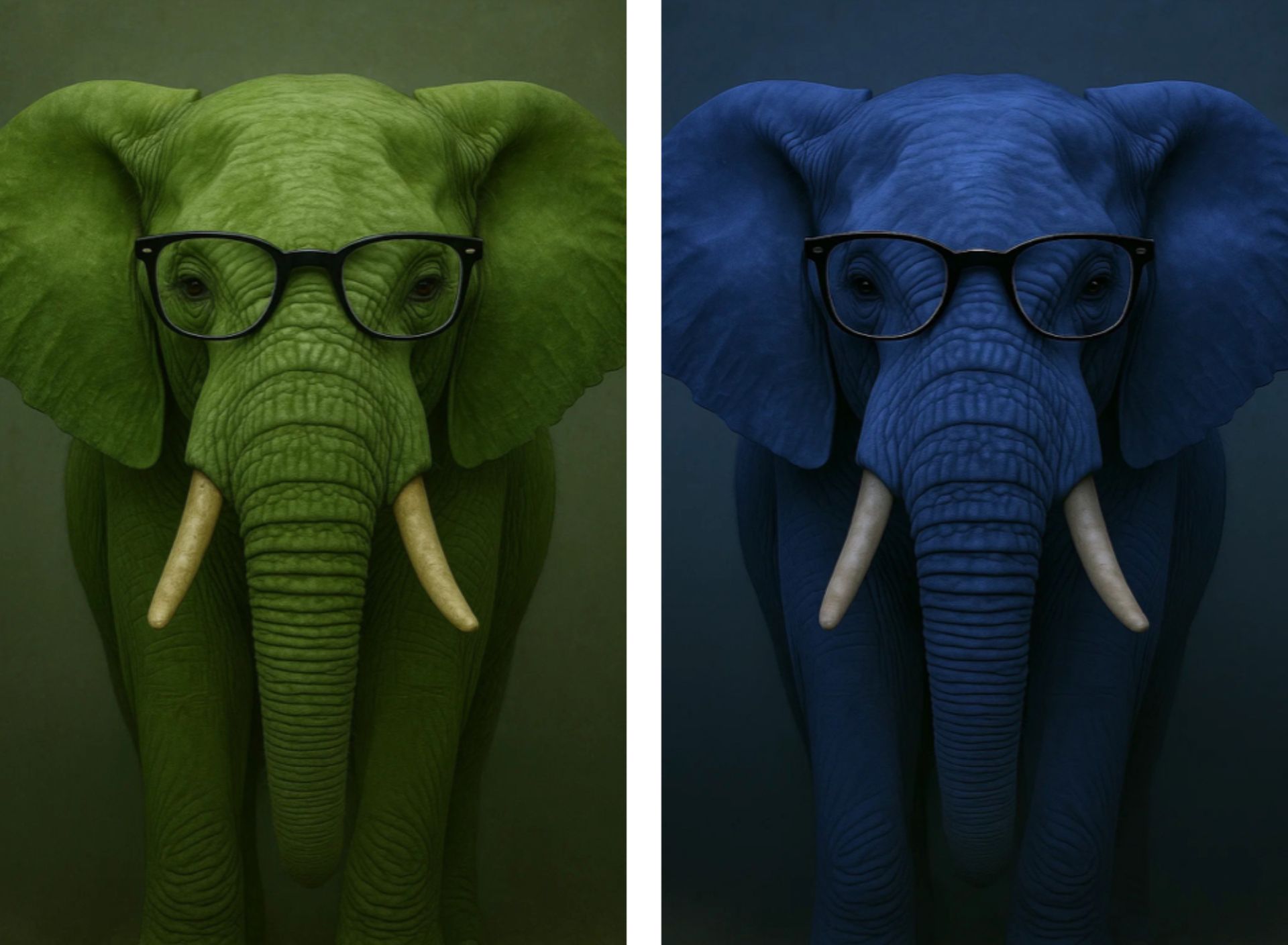
Look at the spectator and tell him that he must think of an elephant with glasses.
Then seem to remember that the ball ended up under the BLUE cup (example) and say:
"Do you remember the color of the cup earlier? It was... blue.
So, to summarize: a BLUE elephant with glasses."
Open the Himber wallet and show that everything was planned from the beginning.
Just a glass of water

Here is a completely Propless trick that you can present anywhere since it requires no material.
The mentalist invites two spectators to join him on stage.
We will call them Antoine and Brigitte.
The mentalist explains that on stage there is a virtual side table and on this side table there is a glass full of water, also virtual.
The mentalist continues by explaining that in a moment, one of the two spectators will have to approach the side table and pretend to drink the glass of water.
The mentalist says he will have his back turned and will not know who drank the glass of water. He specifies that he will ask two questions (which will require a yes or no answer). Only one question per spectator.
The mentalist adds that for each of the two questions, each spectator can lie or tell the truth. To do this, and so that the entire audience follows the procedure, the magician (still with his back turned) asks each spectator to choose between "LIE" and "TRUTH".
The spectator(s) who choose "TRUTH" must raise their right hand.
The spectator(s) who choose "LIE" must raise their left hand.
Thus, the entire audience will know who chose what.
THE ROUTINE BEGINS:
One of the two spectators approaches the side table and drinks the glass of water.
This spectator returns to their place.
The spectators raise their right or left hand.
The mentalist asks the first question (for example to Antoine):
"Antoine, did both of you raise the same hand?"
The mentalist asks the second question (now to Brigitte):
"Brigitte, did you drink the glass of water?"
MODUS OPERANDI:
If the answer to the first question is "YES", you will know that the person will tell the truth for the second question.
If the answer to the first question is "NO", you will know that the person will tell a lie for the second question.
THAT'S ALL AND IT'S AS SIMPLE AS THAT.
You don't need anything. You can do it anywhere.
Nothing to bring on stage. Nothing to remove from the stage.
Nothing to pack in a suitcase. Nothing to load into the car trunk.
COLOR COGNITION TEST CARD
This test really exists. The subject must name the color in which the word is written.
For example, if the word "WHITE" is written in green: the subject must say "GREEN".
And it's not that simple. The provided card has two sides. Only the BACK side will be useful to you; the FRONT side is a red herring and you will ignore it.
FRONT: COLOR COGNITION TEST CARD
BACK: Printed in collaboration with Stanford University, US
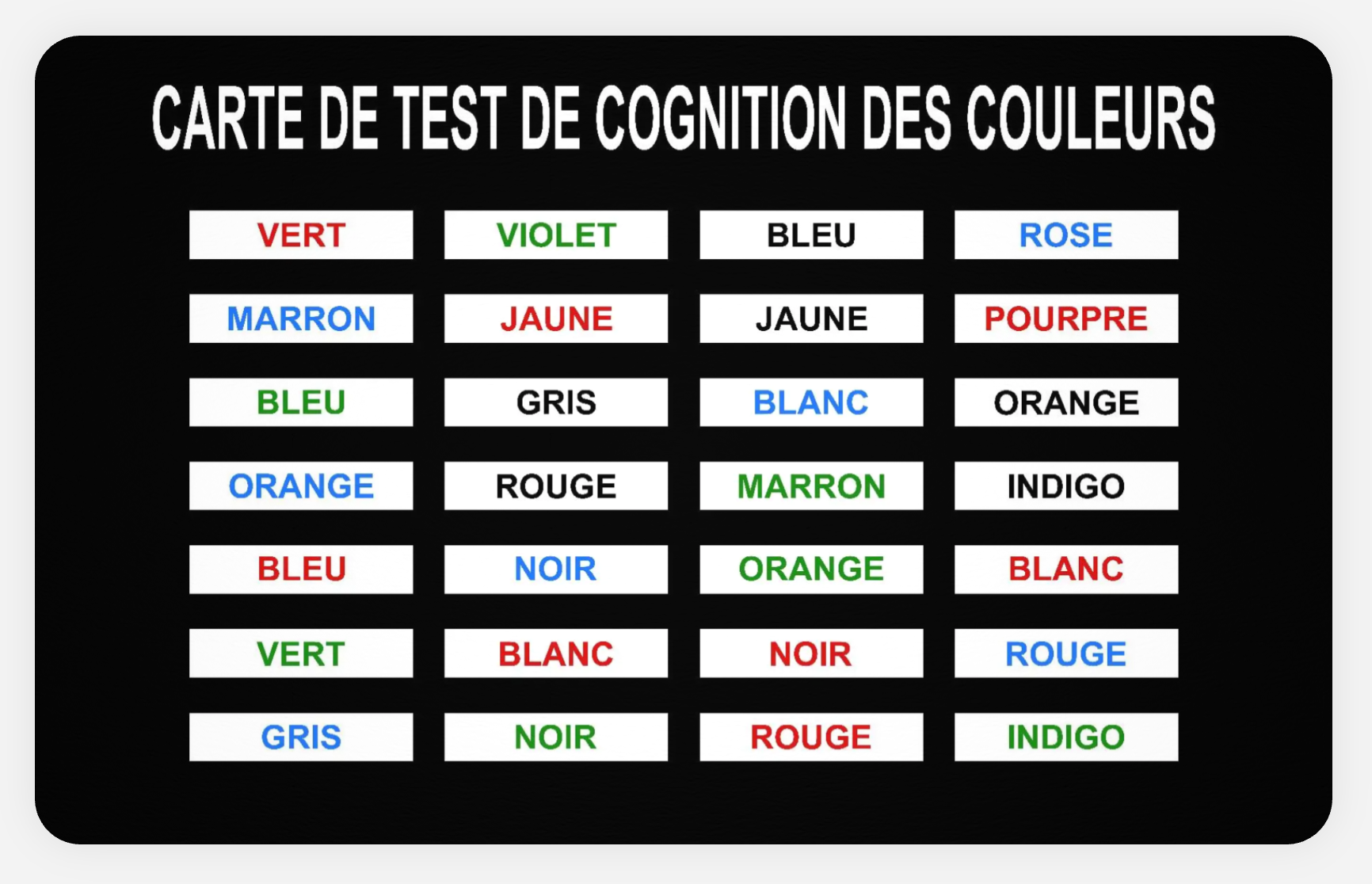
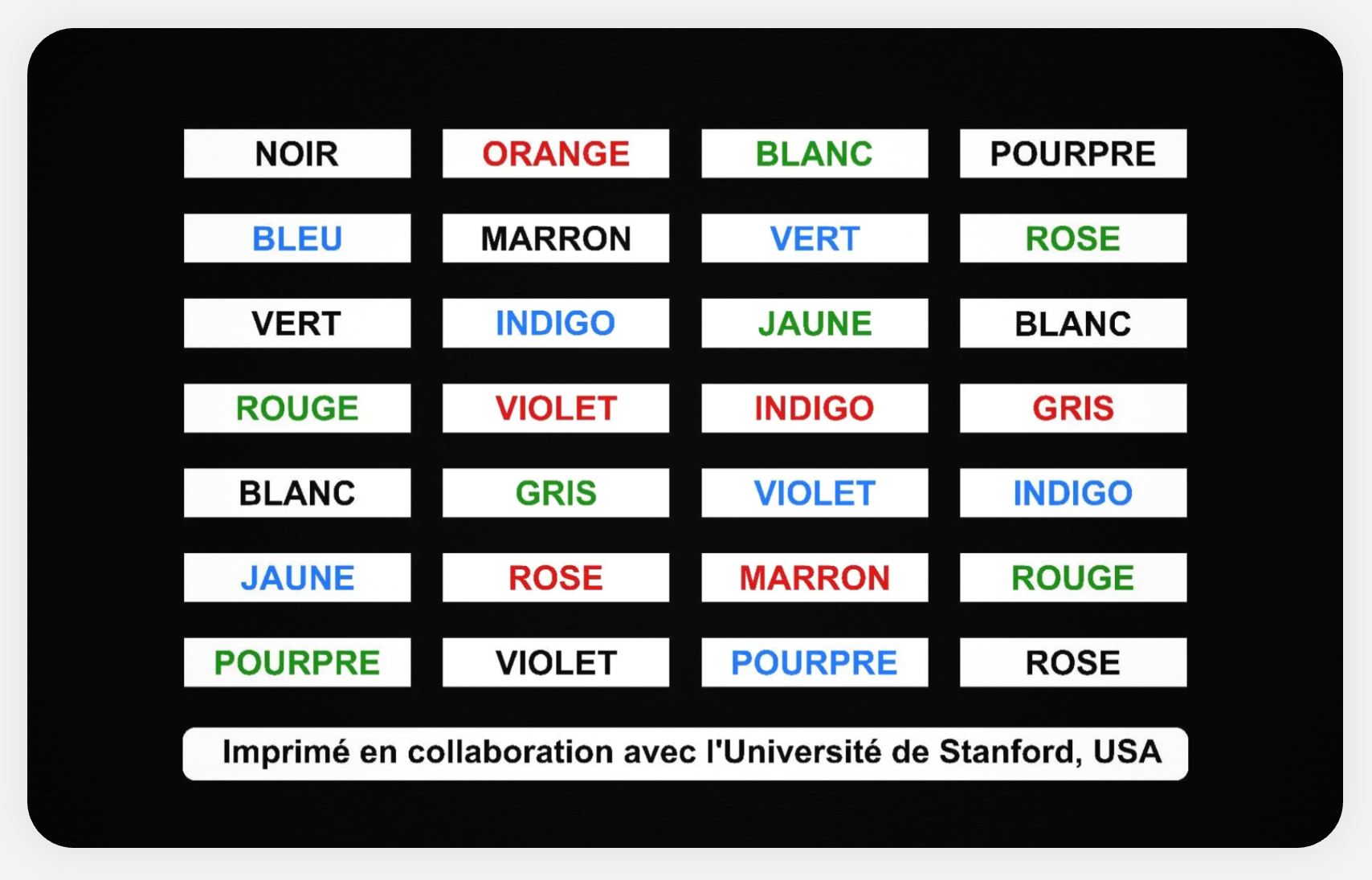
When the spectator holds the card, it's easy to see which way they're holding it.
There are 13 colors written, but only 4 printing colors.
The 13 written colors are: BLACK / BLUE / GREEN / RED / WHITE / YELLOW / PURPLE / ORANGE / BROWN / INDIGO / VIOLET / GREY / PINK
The 4 printing colors are: BLACK / BLUE / GREEN / RED
These are the first 4 found on the BACK side.
These are also the 4 colors that will allow you to guess the color freely thought of by the spectator.
We will use the binary system for this.
BLACK: 1 or 0
BLUE: 2 or 0
GREEN: 4 or 0
RED: 8 or 0
Furthermore, once you have added (or not) the obtained numbers, you will only have to count from top to bottom (on the BACK side) of the first column, then if necessary, continue in the second column to find the thought color.
NOTHING TO MEMORIZE. EVERYTHING IS IN FRONT OF YOUR EYES.
How to add?
Let's take an example: the spectator thought of the color "WHITE".
You give him the card and ask him if he sees his color written in "BLACK" for both sides of the card.
(BUT YOU WILL ONLY TAKE HIS ANSWER FOR THE BACK SIDE INTO ACCOUNT).
If he says "YES" for the BACK side, you count "1", if he says "NO" you count "0".
In our example: "WHITE" is indeed written in black on the BACK side, so you count "1".
You continue and ask him if he sees his color written in "BLUE". If he says "YES" on the BACK side, you count "2", if he says "NO" you count "0".
In our example: "WHITE" is not written in "BLUE" on the BACK side, so you count
"0". We are at 1 + 0 = 1.
You continue with "GREEN" for "4" then with "RED" for "8".
In our example: for "GREEN" you will count "4" and for "RED" you will count "0".
So for "WHITE" we get: 1 + 0 + 4 + 0 = 5.
You just have to count up to five (still on the BACK side) to arrive at the word
"WHITE". The color thought of by the spectator.
Remember that only the BACK side is useful; you will ignore the answers given for the FRONT side. It's a decoy that prevents the system from being traced.
Once again, you don't have to memorize anything. Everything is always before your eyes.
When the spectator answers, you immediately know if he is answering for the BACK or FRONT side.
This plastic card is credit card sized. So you will always have it with you.
iPhone Calendar
The magician takes out his iPhone from his pocket and opens it to his calendar and a deck of cards.
He scrolls through a few pages of the calendar to familiarize the spectator with it.
Then the magician ribbons the 52 cards and cuts the deck.
The deck is shuffled by a spectator.
The first card of the deck will be turned over by the spectator; its value will indicate a month
(example 5 = May).
The second card of the deck will also be turned over by the spectator; its value will indicate a day (example 4 = 4th day).
So, May 4th.
The spectator looks in the iPhone calendar to find May 4th; the magician has written:
"five of spades."
The spectator turns over the shuffled deck himself; under the deck is the five of spades.
There are no duplicate cards.
The deck is truly shuffled and then handled by the spectator.
The trick is automatic.
CALENDAR PREPARATION:
Write "five of spades" on May 4th (4/5) and "six of spades" on April 5th (5/4).
You will fill all the other days of the year with the names of other cards.
MATERIALS:
- You will need a deck of 52 cards with asymmetrical backs. Be careful, this asymmetry must be visible on the left edge of the cards when the deck is spread in a ribbon. I use the "Zodiac Bridge" deck (reference: Art.12114 from AGM Swiss Playing Card). However, since only 3 cards need to be identified in the ribbon, you can very well mark these 3 cards yourself and use another deck.
- You will write "five of spades" on May 4th and "six of spades" on April 5th.
DECK SETUP: (from top to bottom, backs visible):
A "4", a "5", 23 assorted cards, the "6 of spades", a "5", a "4", 23 assorted cards, and the "5 of spades".
All cards will be oriented in the same direction except for the three mentioned "5s", which will be oriented in the opposite direction.
PRESENTATION:
Show the calendar and explain the similarities between the calendar and playing cards.
Place the iPhone on the table.
Ribbon the cards on the table and cut the deck in half,
i.e., just above the flipped "5".
Ask a spectator to riffle shuffle the two packets.
At the end of the shuffle, on the deck, there will be a "4" and a "5" but in a random order.
This is the principle of a palindrome with a few cards (here, two cards).
Under the deck, you will have either the "six of spades" or the "five of spades".
Ask the spectator to ribbon spread the cards and identify if the top card and
the card underneath are oriented in the same direction.
- If both cards are oriented in the same direction, the top card of the deck will indicate the month and the second the day.
- If both cards are oriented in opposite directions, the top card of the deck will indicate the day and the second the month.
Ask the spectator to look at the day formed by these first two cards.
Have them turn the deck face up; the card at the bottom of the deck will be the one written on the said day.
THE NUMBER 9 AND THE LUCKY NUMBER
A PROPELLER-LESS TRICK THAT CAN BE PERFORMED OVER THE PHONE
The magician asks the spectator to type their lucky number on their phone's calculator. Then to type the "X" sign. The magician explains that such a number could allow them to win the lottery or any other type of money game.
The magician asks the spectator to imagine a sum between 9000 and 10000 euros, telling them to choose a complicated sum with only different digits.
Of course, the first digit typed will be a "9".
The spectator types this 4-digit number on their calculator, after the "x" sign.
Then the spectator types the "=" sign.
The magician asks the spectator for the result of the multiplication.
While stating that they cannot know either the lucky number or the desired amount.
However, the magician says that they will (after a pseudo-study of the spectator's personality) try to find these two numbers.
EXAMPLE:
Lucky number: 8
Desired sum: 9543
8x9543=76344
For the lucky number, just add 1 to the first digit of the result.
7+1= 8
From there, you just need to divide: 76344 by 8 to get: 9543
PLUS:
It is possible to ask the spectator to choose a number between 90,000 and 100,000;
the trick will also work.
Thus, the spectator's choice will be among 10,000 possibilities, instead of 1000.
Cryptogram
Always with the wonderful number 9 and especially
the idea of the slate to present the same result twice
but without the spectators realizing it.
An idea that can be used in many routines.
Ask two spectators to take out their calculators and type the three digits of their credit card cryptogram.
Then ask them to mentally add these three digits to obtain a two-digit number.
Have them subtract this two-digit number from the three-digit number of their cryptogram.
Both spectators will obtain a two- or three-digit number.
Have them reduce it to a single-digit number.
Both will get the same result on their calculator: 9.
Look at the first spectator and write this number 9 on a mini-slate and show them this result. The spectator will acknowledge that it is the number they have in mind.
Erase this number and rewrite it to show it to the second spectator.
They too will acknowledge that it is indeed their number (without knowing that their result will be identical to that of the first spectator).
Examples
456 ... 4 + 5 + 6 = 15 ..... 456 - 15 = 441 .... 4 + 4 + 1 = 9
813 .... 8 + 1 + 3 = 12 ..... 813 - 12 = 801
.... 8 + 0 + 1 = 9
Particle
In Volume 2, I described an adaptation of Jim Steinmeyer's excellent trick.
Here is another one, this time no longer with playing cards but business cards.
The magician presents the business cards of nine personalities.
HONORE DE BALZAC
ALFRED DE MUSSET
LOUIS DE FUNES
ROBERT DE NIRO
CHARLOTTE DE TURCKHEIM
LEONARD DE VINCI
LINDA DE SOUZA
CHARLES DE GAULLE
GODEFROY DE BOUILLON
Before giving instructions, the magician turns their back to the audience
so as not to see the actions they will ask the spectator to perform.
The nine cards are given to the spectator to shuffle.
The spectator is invited to distribute the nine cards (backs visible)
into three piles of three cards.
The magician then invites the spectator to lift one of the three piles and to note the card underneath that pile.
The spectator is also invited to remember the spelling
of the personality's name.
The magician asks to place the lifted packet on one of the other two, then the combined two on the third.
The magician does not know the name of the personality
that the spectator has noted.
It should also be noted that all personalities have a name composed of three words.
The magician asks the spectator to spell out the first part of the personality's name they noted, spelling it letter by letter and placing the top card of the packet (backs visible) on the table for each letter spelled.
Note that some names have nine letters; in this case, nine cards will be placed on the table.
If any cards remain (after this first spelling), they will be placed in a block on top of those on the table.
The magician asks the spectator to pick up the cards on the table and spell out, as before, the second part of the personality's name
"de or du", placing two cards, one by one, on the table.
The remaining cards will be placed (as before) in a block on top of the cards on the table.
For the last and third time, the same procedure is repeated, this time with
the third part of the personality's name.
EXAMPLE
For "HONORE DE BALZAC"
First spelling: H.O.N.O.R.E (i.e. 6 letters)
Second spelling: D.E (two letters)
Third spelling: B.A.L.Z.A.C (i.e. 6 letters)
The packet is reassembled as before and held in the spectator's hand.
The magician asks the spectator to name, one by one and in order,
the names of the nine cards.
The magician will then be able to reveal the one the spectator noted.
In all cases, it will be the fifth one named.
It is then up to them to reveal it in the way of their choice.
Credit:
Adaptation of a card trick by Jim Steinmeyer.
Additions:
All first words having more than two letters eliminates the impossibility of presenting the trick with a one or two letter word (as in Jim's version).
All last words have more than four letters.
Automatic placement of the card to be found in the third position,
by the requested distribution into three piles.
Plus:
I like the idea of moving away from the usual use of playing cards.
Possibility for the magician to take the cards back,
without the spectator naming them.
The magician will place the cards behind their back and remove the one seen by the spectator.
I believe this is an important plus that will enhance the revelation.
Note that once the three packets are gathered into one, the spectator can spell the name of another personality (instead of the one they noted), the trick will work the same way and they will still land on the card they noted.
Nine other personalities with a particle name:
PHILIPPE DE BROCA
SIMONE DE BEAUVOIR
PIERRE DE COUBERTIN
GENEVIEVE DE FONTENAY
CECILE DE FRANCE
GERARD DE NERVAL
PIERRE DE RONSARDGERALD DE PALMAS
DOMINIQUE DE VILLEPIN
Thus, you can give nine cards to one spectator and nine others to another.
Both spectators will perform the same instructions* simultaneously, and the magician will discover the names of the two chosen personalities.
* Note that in this way, everyone will realize that the spelled words have a different number of letters, which will add to the incomprehension of the trick.
My Facebook friends
You have received eleven business cards from fake Facebook friends.
Give these cards to a spectator and ask them to shuffle them.
Then to deal them, one by one, into two piles. Since the number of cards is odd, they will have one card left in their hand. Ask them to remember it, then place this card back on one of the two piles. Place the other pile on top of the one where the card, just memorized, is located.
Show the top card to a second spectator so they can memorize it
and put it back in place.
Show the bottom card of the deck to a third spectator so they can do the same and put it back in place.
Now, you will deal the cards, one by one, into three packets.
The first on the left - the second to the right of the first - the third to the right of the other two - the fourth on the third - the fifth on the second - the sixth on the first - the seventh on the fifth - the eighth on the fourth - the ninth on the eighth - the tenth on the seventh - the eleventh on the sixth.
What matters is that the three cards seen are
in the leftmost packet.
Now, you will pick up these three packets to reassemble the deck.
To do this, you will pick up the center packet with your right hand, then the right packet with your left hand, you put the packet from your right hand back in the center, you pick up the left packet with your right hand, you put the packet from your left hand on the first packet you put down, then the last packet from your right hand on top of everything.
The three cards seen will be on top of the packet.
Ask the first spectator for the first name of the card they memorized and spell this first name, placing the cards from the top of the packet onto the table one by one.
Place the remaining cards on top, then spell "D.E", place the remaining cards on top, and finally spell the name of the memorized card and place the remaining cards on top again.
Take the top card of the packet and set it aside, without showing it.
Follow the same procedure for the other two cards.
Turn over the three cards set aside; these will be the chosen cards.
Note that the phone numbers on the cards
are all multiples of 9.
That might be useful...
Dish of the day
Based on a routine by Jim Steinmeyer
"MORE THAN A TRICK... A TOOL THAT WILL ALLOW YOU A MULTITUDE OF ROUTINES"
The magician presents the business cards of nine restaurants.
CAFE DE PARIS
SAVEURS DU MONDE
CUIINE DE NAPLES
DOUCEURS DE KYOTO
BRASSERIE DU CENTRE
ATELIER DU BURGER
CUISINE DU TERROIR
BISTROT DU MARCHE
TAVERNE DE CANCALE
Before giving instructions, the magician turns their back to the audience so as not to see the actions they will ask the spectator to perform. The nine cards are given to the spectator to shuffle them.
The spectator is invited to distribute the nine cards (backs visible) into three piles of three cards.
The magician then invites the spectator to lift one of the three piles and to note the card underneath that pile. The spectator is also invited to remember the spelling of the restaurant's name.
The magician asks to place the lifted packet on one of the other two, then the combined two on the third.
The magician does not know the name of the restaurant the spectator has noted.
It should also be noted that all restaurants have a name composed of three words.
The magician asks the spectator to spell out the first part of the restaurant's name they noted, spelling it letter by letter and placing the top card of the packet (backs visible) on the table for each letter spelled.
Note that some names have nine letters; in this case, nine cards will be placed on the table.
If any cards remain (after this first spelling), they will be placed in a block on top of those on the table.
The magician asks the spectator to pick up the cards on the table and spell out, as before, the second part of the restaurant's name "de or du", placing two cards, one by one, on the table. The remaining cards will be placed (as before) in a block on top of the cards on the table.
For the last and third time, the same procedure is repeated, this time with
The third part of the restaurant's name.
EXAMPLE
For "CAFE DE PARIS"
First spelling: C.A.F.E (i.e. 4 letters)
Second spelling: D.E (two letters)
Third spelling: P.A.R.I.S (i.e. 5 letters)
The packet is reassembled as before and held in the spectator's hand. The magician asks the spectator to name, one by one and in order, the names of the nine cards.
The magician will then be able to reveal the one the spectator noted. In all cases, it will be the fifth one named. It is then up to them to reveal it in the way of their choice.
Credit:
Adaptation of a card trick by Jim Steinmeyer.
Additions:
All first words having more than two letters, eliminates the impossibility of presenting the trick with a one or two letter word. All last words have more than four letters.
Automatic placement of the card to be found in the third position, by the requested distribution into three piles.
Plus:
I like the idea of moving away from the usual use of playing cards. Possibility for the magician to take the cards back,
without the spectator naming them. The magician will place the cards behind their back and remove the one seen by the spectator. I believe this is an important plus that will enhance the revelation.
Note that once the three packets are gathered into one, the spectator can spell the name of another restaurant (instead of the one they noted), the trick will work the same way and they will still land on the card they noted.
You have also received three other business cards:
AUBERGE DU LAC
POIVRE ET SEL
CREPERIE DU PARC
These three cards will allow you to perform three other divination tricks:
Two switches and a free will.
SWITCH number 1
The magician places the three cards in order:
AUBERGE DU LAC - POIVRE ET SEL - CREPERIE DU PARC
The magician (with their back turned) asks the spectator to mentally choose one of the three restaurants, then to swap the positions of the other two. The magician then asks to swap the positions of the restaurants "AUBERGE DU LAC" and "POIVRE ET SEL". Thus, the restaurant chosen by the spectator will end up on the far right (where the "CREPERIE DU PARC" restaurant was at the beginning of the trick).
The magician will then only have to reveal this position in the way of their choice.
SWITCH number 2
Identical to switch number 1, but this time, the initial order of the three cards will be unknown to the magician.
The magician (with their back turned) asks the spectator to mentally choose one of the three restaurants, then to turn the middle card face down (back visible).
The magician asks the spectator to swap the positions of the two unchosen cards (whether one of them is face up or face down).
The magician asks the spectator to swap the positions of the two face-up cards.
The magician asks the spectator to turn the card that was face down back face up.
Thus, the restaurant chosen by the spectator will end up in the middle of the other two.
The magician will then only have to reveal this position in the way of their choice.
Credit
Many magicians have worked on this switch principle. The latest is Gabriel Werlen.
FREE WILL (new version)
The magician places the three cards in order:
AUBERGE DU LAC - POIVRE ET SEL - CREPERIE DU PARC
The names "AUBERGE DU LAC" and "CREPERIE DU PARC" are written (and spelled) with 12 letters for the first and 14 letters for the second (two even numbers).
The name "POIVRE ET SEL" is written (and spelled) with 11 letters (an odd number).
The magician asks the spectator to mentally choose one of the three restaurants.
Then to spell its name (the three words that constitute it), starting the spelling and placing their index finger on the chosen card. The spectator has the choice to move, card by card, going to the right or to the left and one card at a time.
Whatever card is initially chosen, the spectator will end up on the "POIVRE ET SEL" card. In a way, this card will have been forced.
The magician asks the spectator to turn this card face up.
The magician asks the spectator to place one of the two remaining cards in front of them and to place the last one in front of you.
The rest will unfold as in Deddy Corbuzier's "FREE WILL" effect, either by reading the prediction yourself or by having the spectator read it... I WILL HAVE "AUBERGE DU LAC"
YOU WILL HAVE "CREPERIE DU PARC" ON THE TABLE and FACE UP WILL BE "POIVRE ET SEL"
PLUS
It is possible to use some of these business cards by associating them with the NPA principle.
Principle described in my book "NOWHERE ELSE" published by the Cabinet d'Illusions.
PLUS PLUS
Other effects are also possible with Roy Baker's PATEO force and/or Paul Curry's shuffle: "I place or I exchange."
By combining Paul Curry's shuffle (the cards then being placed one by one face up on the table), you can continue with a PATEO since you will know the order of the cards and therefore the position of the one to be forced.
For the force, I recommend "ATELIER DU BURGER."
You will end by showing your prediction... a real hamburger.
PLUS PLUS PLUS
Two cards have the same first word: "CUISINE DU TERROIR" and "CUISINE DE NAPLES."
It's up to you to use them for a coincidence.
Four cards bear the name of a city in their title: "CAFE DE PARIS," "CUISINE DE NAPLES,"
"TAVERNE DE CANCALE," and "DOUCEURS DE KYOTO."
Here too, it's up to you to take advantage of them...
The cards can be arranged in an alphabetical chain, thus opening the way to other routines.
Here too, a Paul Curry shuffle/deal will not destroy your chain.