
In brief
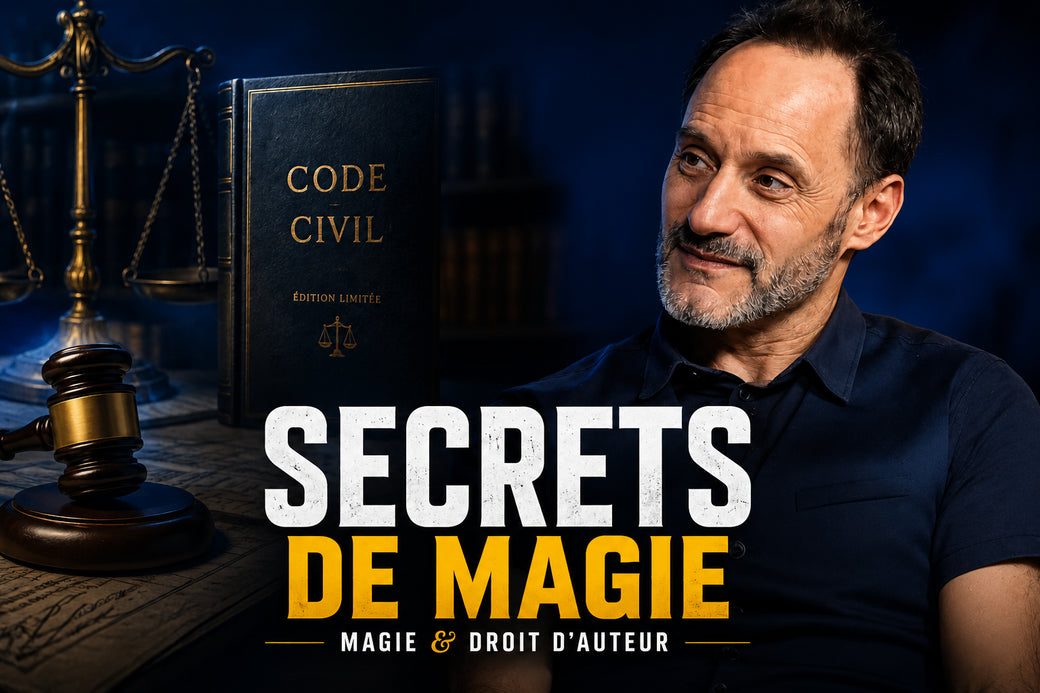
Guilhem Julia explains why a magician’s creation poses a legal question about what is visible and what is secret. A patent makes the description of a mechanism available, which conflicts with the need for secrecy. Some sleights might, however, be seen as choreography, opening another way to think about protecting concealed moves.
In this new episode of Détours de Magie, we have the pleasure of welcoming Guilhem Julia, with whom we will discuss the topic of copyright and magic.
On the agenda:
Presentation of his dual career as an award-winning magician and lecturer in law.
The basics of copyright law.
Protection of personal routines (SACD).
The thesis: "The Magic Work and the Law".
The legal status of secrets.
The debate on the "right to information".
The creative value of a trick.
Copyright vs. Patent.
Case study: The "Flying".
The Teller case (Trick "Shadow").
The patent paradox: Horace Goldin.
Performance rights.
How to practically protect your creation.
The "choreography of the invisible". Ethics, history, and community.
Transcription:
Some time ago, you probably saw in the news that a masked magician was unmasked thanks to an investigation. This raises more than ever the question of what we have the right to do in magic and the secrets we have the right, or not, to reveal.
Based on that, we are going to have a discussion with Guilhem Julia, who will talk to us about law and magic.
Hi Guilhem.
— Hi Thibault.
So, for those who don't know you, you have done a lot of things. You have several routines already: you have the Fish Act, the Paper Act, which you presented at different competitions. You won awards, FFAM awards, FISM awards, I believe. And you are also a lecturer in law, which naturally led you to offer lectures that combine law and magic.
Could you explain to us a little, in a few words, so that we can clearly understand what it is about, what law is in general, copyright even, since that is what concerns us here, and what link you found with magic? How is copyright special to magic?
— Copyright, in fact, is a component of a broader set that is intellectual property law.
Intellectual property law is the law that protects creations of the mind. And we will have several rights within intellectual property law, notably trademark law, patent law, and we will also have copyright.
Each of these rights applies to a different creation of the mind.
For example, trademark law is for distinctive signs by which a competitor identifies their activity vis-à-vis other competitors.
Copyright, on the other hand, applies to works of the mind, that is to say creations such as creations from the field of arts, traditionally the field of aesthetics, what we call the fine arts: song, cinema, literature.
But copyright has seen an extension to a certain number of other arts, notably what is called the applied arts, so everything that touches the field of industry, for example, and also the arts of new technologies, notably everything related to the Internet.
And so, in copyright, we will find notably creations of live performance, so circus, etc.
— Ah, that's something in it too?
— Absolutely. The circus is indeed part of the protected works. Precisely, the law says "circus act and routine".
— And the expression is a bit curious.
— Exactly. And when we look at the parliamentary work on this law, we see that in fact the legislator probably wanted to generally encompass the arts, also magic, and not just the circus arts.
And that is why we have this somewhat hybrid terminology: "circus act and routine".
— Do you think, finally, in what you say, in the report, it mentions magic or not?
— No. No, never explicitly. And that is why we had quite a few doubts about whether magic was protectable or not by copyright.
— And so you say, it protects the arts, finally, the applied arts, is that it?
— Yes.
— Do we have... So, I know there are actions being taken, and by the way you are well placed to talk about it, on the fact of making magic recognized as an art in the UNESCO heritage, etc.
And we invite you to go see the video we made with Dominique, which talks about Mac 5 and this crazy and exciting project of putting magic at UNESCO.
So it's great, go see Mac 5 and go see the video if you haven't seen it.
And so, does that mean that if magic, in quotes, is not recognized as an art, it might not be protected by copyright?
— So, it's not exactly that, because what is protected by copyright is the work of the mind, as I was saying.
And every work of the mind is not necessarily an artistic work.
That is to say that the notion of work of the mind is a legal notion, while the notion of artistic work is a notion that is much more subjective, which will be proper to each, according to their discourse, according to their values, etc. And it is not recognized as such by the law.
I will give you a very simple example: an ashtray, a priori, is not an artistic work. It can be protected by copyright.
— A salad bowl also.
— That is what we call the applied arts.
— There. And it is not, in the classic artistic sense of the term, in fact.
— Okay.
Silly question, but so you have done routines. We can talk about it a little bit too: you, as a magician, you have had awards, etc. You have done Fish Act, Paper Act notably. Did you protect your routines?
— Yes. For Fish Act, in fact, what I had done was that I had made a deposit with the SACD.
— OK.
— A deposit of the routine's flow and the techniques of the routine.
That is to say that, for that routine, we had developed with Raphaël Navarro — who had worked on Fish Act — a technique that allowed to make goldfish appear, but having free hands, well empty hands before the appearance and especially after the appearance.
Which was obviously a great novelty compared to existing methods.
And there, we had created a gimmick, in fact, that we had described in the SACD deposit.
But one thing must be clarified: a SACD deposit, it does not allow, in principle, to protect the technical part of a magic creation.
It allows to protect rather the narrative part, the visible part, that is what the spectators see.
As if I were protecting, for example, a text of a play, a text of a novel.
And so me, it is before all the flow, the narration of the effects that I had wanted to protect.
I had also described the techniques, but I do not think that a SACD deposit can protect the technique, because copyright does not protect what is secret.
— But there, you are talking about technique in the sense of manipulation or technique in the sense of manufactured gimmick?
— In this case, technique in the sense of manufactured gimmick.
— And so there, somewhere, the gimmick, it is an object, it is something physical. And so that, we cannot protect it in one way or another by copyright?
— It will be complicated. It could be, in the case of a magic gimmick, by an invention patent.
— Ah, and so there, we are no longer in copyright, we are in patent law.
— Exactly. But the gimmick would have to meet the conditions of the invention, and that, that is quite complicated: meeting the conditions of the invention.
— OK.
Just before we continue a little on all that is law and patent, etc., I would like us to come back a little on your background and why it happened naturally that you mix magic and law, in any case that you offer lectures on magic and law, by your training, I suppose.
— It was quite curious.
I think we have to go back to my Master 2 year, where I had done a Master 2 in international law, so nothing to do with, obviously, intellectual property, and even less with magic.
But magic, I was already practicing it on the side. I had been a magician for a long time, indeed.
And then, in fact, I wanted to continue the research. Legal research pleased me a lot. I had done a Master 2 thesis and I wanted to go further.
Naturally, the training director offers me to do a research in the field of international law. He offers me topics, there is nothing that pleases me.
It must be known that we still commit to a duration of five or six years for the writing of a doctoral thesis, so you have to be sure, you have to love and be sure of your topic.
And there, in fact, it is by discussing with a magician friend — and I believe it is Raphaël Navarro, by the way, him again — who tells me: "But listen, it would be amazing to think about the relationship between law and magic. Here, could the law protect the creations of magicians?"
And there, there was the spark of saying: "Here, that, that is an original topic."
And I submitted it to my thesis director, who, not only was not a specialist in magic, but who was not a specialist in intellectual property either.
And he still accepted to direct this work and accepted to follow me.
We even obtained a regional funding to help this work.
There, and that is how in fact I made the link between my studies and my passion as a magician.
And in fact, after, I wanted to share the fruit of this work with non-lawyers.
So I started to offer to magicians, but also to the general public, a lecture that was a vision, let's say, accessible, a little popularized of my doctoral work, which is still 500 pages, I believe, and which is quite pointed necessarily.
But there, the idea, it was to show, to sensitize also the general public to the attacks that creative magicians suffer in their work.
We will maybe talk about it later, and how the law can come to the rescue, and what are the weaknesses also of the law compared to these magic creations.
And it was a quite personal work, necessarily, because I nourished it also from the work that I was doing at the time on my magic routine, notably Fish Act, that I presented in different places, notably abroad.
And how people protect themselves in different countries? Were there trials, things like that?
And so the thesis really nourished from all these experiences on the ground, from all these meetings that I had.
It pleased me a lot to do that and I do not think that I could have done another research work than this one.
— And that is what is interesting, it is that you have a little all the hats.
That is to say that you are at the same time a lawyer, but also a magician, and at the same time you perform routines on which there is a notion of... It is important to protect certain ideas, etc.
So you have a little all the hats that allow you to be almost the most legitimate to do a work like that.
Could you tell us, in two words, what the thesis was precisely about, then? About copyright in magic, is that it?
— So, the thesis, it was called "The Magic Work and the Law".
— The Magic Work and the Law, that is it.
— And my idea, it was to show that the magic work did not look like any other classic work of the mind that copyright knows.
To say it in two words, the specificity of the magic work compared to the musical work, compared to the circus work or the theatrical work, is that in fact it rests on a duality which is what people see and what people do not see.
The public, there is the impossible aspect of magic, and there is the secret aspect, that is to say the methods put in place to simulate magic.
And so that, that is an incredible challenge for the law because we say: but what does the law apprehend?
Does it apprehend what we see, what we do not see? Does it protect what we see, what we do not see? Does it not protect either of the two? Can one be protected without the other?
And so it is indeed a kind of challenge.
I envisioned that as a challenge: to say "Good, what can the law offer as a solution?"
And so very quickly, I oriented myself towards intellectual property law, copyright, industrial property law.
But I also looked at what existed of things at the level of unfair competition, at the level of trade secret, professional secret, that is to say notions, tools that exist in law, but which had never been yet applied to magic.
— And so, are there or not?
— It is complicated. It is very complicated.
Notably, for example, because the secret of the magician, the secret of the creator, in any case of magic trick, is not recognized by the law as a professional secret.
That is to say that there are rights, secrets that are recognized by the law: the secret of our origins, the secret of privacy, the secret of instruction, the medical secret.
These secrets, they are recognized by the law. That is to say that if someone violates this secret, he is liable to criminal prosecution very often, because we have texts in the Penal Code, in the Public Health Code, which say that the violation of this secret entails a certain number of prosecutions and convictions.
The secret of the magician is not recognized as such, is not recognized as professional secret.
Which makes that we can have — we will surely talk about it too — videos on social networks, notably of debunking secrets, which cannot truly be the subject of prosecutions and convictions.
— We cannot find another motive than the infringement of copyright, finally, when you make a video, for example, that explains?
It is a little like if you put at the free disposal a... I do not know, it is like if you scan a book to put it online, finally, somewhere, since you explain the method.
It is like if you give the whole novel.
— Yes and no, because explaining a method, it is not necessarily like making a copy of a book, because we will consider that the method is not truly protectable.
That is the whole problem.
The use of the method, that is to say the presentation of a magic routine including a method, it will be accepted and protected under copyright.
— The presentation.
— Exactly, the staging, the visible aspect of things.
But the method, the secrets put in place as such are not truly recognized.
That is the problem.
And worse than that, at the time when there was the first masked magician on TV — it was Leonardo Valentino, the American magician — there was a show produced by Fox.
And in fact, the television program broadcasters said: "But in fact, the public has the right to access information. There are plenty of documentaries on cinema special effects. Why would there not be documentaries on the effects of magicians, on the secrets of magicians?"
So there was even, in the name of a public right to information, a kind of legitimation of the revelation of magic secrets.
It went that far anyway.
— And what do you think of the validity of that argument?
— It is totally false.
Because in fact, I will know that in Jurassic Park the dinosaurs are not real dinosaurs. It is not going to ruin my pleasure discovering the movie at all.
On the other hand, I will know the method that allows the partner to hide in a special box for a magic trick: it will distort my perception of the magic trick.
And there, it comes back a little bit to the sensation that would have, for example, the reader who will read in a press review the final twist of a detective novel.
The detective novel may be very well written, as soon as you know the end, you know the outcome. It distorts your reading, it distorts your feeling.
And I would even say that it ruins the pleasure.
And so, obviously, that the magic creation does not rest entirely on the secret, on the modus operandi, but it rests at least on it.
That is to say that the very thing of the magic trick, it is still the questioning in front of what appears to be real magic.
Otherwise, it is theater. It has other qualities, obviously, but we still remove a substantial part, I believe, of the magic creation, namely: "I do not understand how it works."
— You are right. But that is where it is all the more important to have not just a trick with a thing, but to have a real wrapping, a staging and added value.
Because indeed, if your trick summarizes itself, or your routine summarizes itself, to the modus operandi, you... It is only a puzzle, in that case. You will not go far.
And indeed, I understand that you can be bothered by the masked magician while that, if you put a real staging, etc., there already it will impact you less, because people will come for your show more than for magic in the strict sense.
— And I totally agree.
And I even believe that what was very prejudicial in the practices of the masked magician at the time, and of the magician on Instagram whose identity was revealed recently, is that in fact they reduce precisely the creation of the magician to a simple thing that we can disclose and which is terribly simple and vulgar.
And that, in fact, is extremely demeaning compared to creative work, compared to the work of staging, of dressing up the magic trick, which is, in my opinion, essential today and which we see more and more with initiatives like new magic, narrative magic, theatrical magic.
We see shows that mix music, magic, ecology, a total art, history and magic.
And so we are not at all simply in puzzles whose solution needs to be found.
We are well beyond that.
But the practices of those people who debunk magic tricks diminish magic a little and give it a completely biased and prejudicial image.
— Yes. And also some magicians, unfortunately.
Because there are magicians who, for example, when they buy a trick — because so we buy tricks — are disappointed by the gimmick.
We receive it and, in fact, that, I never understood.
I mean, I see the "disappointed" side in the financial sense, perhaps, of the term. We say to ourselves: "Ah, I gave so much to receive this."
But in fact, it is reducing magic to a piece of plastic, ultimately. Reducing magic to a piece of cardboard.
And if we have this feeling of being disappointed, it is perhaps also that we need to review this notion of... In fact, magic is not just that. It is not just reduced to the secret.
— Especially when you pay €70 just for a gimmick card. In fact, you are not paying for the gimmick card.
You are paying for the author's work. You are paying for the creativity, the research, the thinking, the staging, everything you want.
But you are not just paying for the material.
Otherwise, we would not buy iPhones for $1,300.
— Absolutely.
— If we bought them at manufacturing cost, it would not be the same price.
— And about the magician who is disappointed when he buys the trick, I think back to a phrase by Jean-Pierre Hornecker, a very well-known great trick merchant, with whom I had an exchange.
He said that in fact, the magician is a spectator who doesn't know it when he buys the trick and is disappointed.
And I find that very true.
He said that we have a bit of a voyeuristic side: we buy to know how it works.
And finally, like any spectator, we are always very disappointed, almost all the time very disappointed, because all the work only comes after, in reality.
And sometimes, some people do not necessarily want to do this work or imagine that the material would do it for them.
Which is sometimes the case too, but that is not enough, in any case, to make magic an art.
— That, that is certain.
It is true. It is a bit the problem of magic too, because after, there, we are moving away a bit from copyright, but it is that it is one of the only arts where you can pay to shine.
That is to say: you want to make someone disappear, you buy your grand illusion for $5,000, you make it disappear and you are the best magician on the planet.
On the other hand, if you want to sing or play a musical instrument, there you cannot pay your $5,000 and be a maestro. You have to work.
And magic, I think it is one of the only arts precisely where there is this bias.
Conversely, people who just have a deck of cards sometimes perform miracles.
Finally, I mean, it is completely... It is different, of course.
And I think it is interesting to highlight that too.
But well, we could debate for a long time on this question of what goes beyond the secret, and which is even squarely on the staging and on what we do.
Obviously magic is not reduced to its material and a trick.
But that is the image that some can give.
And in fact, there is a big difference between doing a magic trick and being a magician.
And that, unfortunately, I think there is a confusion that is often made between the two, by magicians and the public.
— Yes, indeed.
And can you, if we go back there to all that is copyright and patent, for example, explain to us the difference between a copyright and a patent?
Finally, what is... What is the difference between copyright and patent, for example?
— In fact, they do not protect the same thing.
Copyright, as I was saying, will protect a work of the mind that is taken in its visible aspect.
For example: a song, a book, a magic act, a sketch, a drawing, a painting.
So we protect the visible aspect in its communication to the public.
The patent of invention, it will protect an invention.
An invention, to put it simply, is a technical solution to a given problem.
For example, the lightning rod, that was an invention.
And so here, we will protect more a mechanism, a process.
So there, we are more on the technical aspect of the thing, and not on the visible aspect, on the aspect of communication to the public.
And so traditionally, copyright was associated with everything that was aesthetic or artistic, even if it is not limited to that, with applied arts, as I was saying.
While the patent is more in a purpose of industry and technique.
That is the big difference.
Beyond that, the big difference is that copyright is free, while the patent is paid.
Copyright, you have it by virtue of creation.
It is very important.
Even if I do not communicate my creation, even if I do not show it, it will be automatically protected by copyright, provided it is materialized.
The simple idea is not protectable.
And also, my creation must be original, that is to say that it bears the imprint of my personality.
— I am not going to file a circle or a square.
— Exactly.
Just as I cannot file the effect of the disappearing elephant or the effect of the flying, a flying man.
— And precisely, where is that limit?
Because in fact, for the flying, you have several methods for that, but the effect at the end remains the same.
And that is actually valid for everything. Of effects, there are maybe about fifteen possible.
— Absolutely.
— There are much fewer than we think.
— Yes. It was Winston Freer notably who had done that. There is a list of possible effects.
There are fifteen, twelve... Finally, it depends on how we count them.
— Once we have gone around the appearance, disappearance, color change, thing... There are not that many.
And so, yeah, it would maybe be a bit indecent if someone said: "Well here, I have the rights on the disappearance."
— Exactly.
And that is why we need to understand well that what matters is not the magic effect, but the presentation that you will make of it.
A very simple example: dozens of magicians practice flyings.
None have been bothered by David Copperfield, who was a priori the first, in the modern version, to have done it.
None, except the one who attacked him at the end of the 90s, Yves Barta, because he had taken the same presentation.
That is to say similar set elements, choreography elements and evolutions that made that, even for the average spectator, it was difficult to distinguish the copy from the original.
But a lot of other magicians, I think notably of Peter Marvey, of Marc-Antoine, have proposed their own version of the flying without ever being bothered in court, obviously, by David Copperfield.
Why?
Because they had appropriated, in a presentation that was their own, this magic effect.
And there, we are not talking at all about the method, because we are on the field of copyright.
We are simply talking about the presentation of this magic effect.
— And conversely, if I do the same staging, basically, because at the same time, a flying, it is true that there are not 36 ways to stage it, even if you can always expand the field of possibilities...
Finally, there are always original stagings to make.
But if you do two visually identical flyings, but with a completely different method, can you have problems or can we say things?
— Yes, on the field of copyright, yes.
— Why?
— And we have a case that we could eventually talk about which shows that.
It is the Teller case with the Shadow trick.
— Can we just recall the Shadow trick?
— Yes, of course.
The Shadow trick, in fact, is a Teller trick that is one of his signature tricks, a magnificent act.
— Go see this video.
— Ah yes, yes. It is easily accessible, notably in the framework of the show Fool Us, where he had presented it.
We have in fact a pantomime, that is to say a silent act, without music, without words, that lasts one minute.
We have in fact a magic shadow, a shadow of a rose in a vase, which will move according to what the magician does.
When he cuts the petal of the rose — well, he cuts rather the shadow — he gives the impression of cutting the shadow and it is the real rose that suffers the blow of the scissors.
And at the end, we have a whole evolution until the magician who starts to bleed on the shadow.
I described it very badly, but it is really a masterpiece.
And so Teller presents this act at the end of the 1970s in the United States and, at the beginning of the 1980s, he registers a copyright — so literally a copyright, over there, a copyright.
And in fact, in the 2000s, we are going to have a mysterious magician, because no one knew him, a mysterious Belgian magician who will propose on his YouTube platform his own version of the effect.
He says to have improved the Teller effect, notably because the vase, in the original version, is an opaque vase. In the version proposed by this magician, it is transparent.
And he says that the method is completely different.
And so not only does he mount this trick, but he proposes to buy it. That is to say that he sells the trick.
I think it was not far from 3,000 dollars anyway, so a certain price.
And in fact, he was sued for copyright violation by Teller.
And one of his arguments is to say: "But the method is completely different from his."
And the judges said, to make it quick: "But no matter the method, visually, the result is the same for a television viewer or an average spectator."
So the court does not care about the method used.
The judges have a lot of humor: they even say that the court does not care to know if it is real magic or not, does not care to know if it is a method that is the same as Teller or not.
What matters is the visual result.
That is what copyright protects.
And in this case, the two visual results are very, very similar.
— So here, to answer your question, yes, we could have an infringement action even if the methods were different.
— And yes, because the result is the same.
By the way, for the anecdote, I think Teller said that the secret behind his act was... Basically, no one had yet managed to understand.
— It was Penn who had said that, right?
— Yeah.
And he had said: "No one will ever know how this trick works."
And precisely, the magician we are talking about, the Belgian magician, had said: "Well that, for me, was a provocation from Penn. A provocation to try to understand and to propose my trick, to propose this trick for sale."
And the judges had said: "Well no. It was eventually a provocation to understand the operation, but not to commercialize a counterfeit of the trick."
— That was another step. You went a bit far, sir.
— Yes, it is true.
— And conversely, if he had limited himself to doing interactions with a shadow and that it was very different from a vase with a rose?
— The whole question is: from when is it different? From when is it a remake? From when is it a counterfeit?
If I simply change the color of the vase, it is not a substantial difference.
We classically say that the counterfeit is assessed according to the similarities and not the differences.
So, if there are more similarities than differences, in principle, there is a counterfeit.
Still, the similarities must be substantial and the differences minor.
If I simply change the color of an accessory, it is obvious that it is not a substantial difference.
— And that, that is the free decision of...
— That gives a lot of legal insecurity, it must be said.
That is what we call the sovereign appreciation of the judges.
So there are a lot of casuistry, case by case.
The judges are not very comfortable, moreover, with magic when they are confronted with it because it is very rare.
It is something quite specific.
As I was saying, they are not trained in this duality between visible and invisible.
The judges, in fact, generally link the magician's creation to a theatrical creation.
And that is why the staging, the presentation, the presence of music, of costumes, is very important.
Because that is what, in my opinion, confers the protection under copyright.
The magic trick as such is not really protectable, because the trick, ultimately, is the idea.
And that, that is not appropriable.
— And that, that is... Or it is complicated.
It is true.
And there, you were saying therefore Teller, he won his trial, and Copperfield too, who made a trial against... I do not know if you are going to talk about it a little, who, for the flying, in fact, won too, it seems to me, because it was copyright.
— You saw, I listened well, huh.
— Very good.
On the other hand, there were other cases, like Horace Goldin, with the woman cut in two.
There are a lot of things to say, notably with the tobacco industries.
Do you want to talk to us about it a little?
— Yes. It is a case that is fascinating, that is older than the others since it dates from the beginning of the 20th century.
But it is fascinating because it shows well the limits of the patent for the magician.
Goldin, in fact, is very well known for having created the modern version of the woman cut in two.
This version where the woman is put in a box, in a horizontal box with the saw.
And he, he had improved that trick because, in his version, we saw in fact the head, the legs and the arms of the partner, which was not the case before in the previous versions, notably of Selbit.
And so Goldin, very, very proud of his improvement, undertakes to patent his creation.
And here, the patent is granted to him.
That is to say that we consider that indeed, the improvement that he brought, the method that he brought to make this illusion of a woman cut in two, responds well to the criteria of the invention.
Notably, an invention that must be new, that must show an inventive activity, that is to say be still quite sophisticated, etc.
— After, the patent, it is on the material side?
— Technical side.
— Technical, exactly.
— Completely technical. The operation of an invention, in reality.
That is what we protect.
And so he obtains his patent for a duration of 20 years and he says to himself that there, he is protected.
And in fact, the violation of this patent will not come from the magicians.
It will come from a cigarette manufacturer.
In fact, it is Liggett & Myers, with the Chesterfield brand, who is in full competitive war with Camel, the other great tobacco manufacturer in the United States.
And in fact, they will together fight with advertising, notably because Camel starts to say that its tobacco is better than that of its competitors because the tobacco is grilled.
And Chesterfield will explain that in fact, it is a fallacious argument, because all tobaccos are grilled in cigarettes.
And so they will launch an advertising campaign that is called "It's fun to be fooled, it's more fun to know": it is amusing to be fooled, but it is better to know.
And they will unveil on the cigarette packs, also in advertisements in paper newspapers, magazines, they will unveil different types of secrets.
Notably the secret of grilled tobacco which is present in all cigarettes, and also secrets of fun physics, little magic tricks.
And at one point, they will unveil roughly, but still, the method of Goldin.
And there, obviously, Goldin, whose patent is still active — a patent, it is 20 years, a non-renewable duration of 20 years — will obviously sue.
And he will lose.
— He will lose under what pretext? What motive?
— The judges will say that in fact, the patent of invention protects the invention at the level of its exploitation.
That is to say that no one can reproduce the act of the woman cut in two with the method of Goldin without his authorization.
— Exactly.
— On the other hand, the patent, by definition, it is accessible. Everyone can inform themselves of a patent.
It is made public. Today, online, we can find quite easily a large number of plans, descriptions of patents.
And so, in fact, what the judges said was: “But Mr. Goldin, by patenting your creation, you have released it to the public and therefore you cannot blame this cigarette manufacturer for revealing the secret.”
— Which, in magic, is still…
— And so, for the magician, it is a terrible paradox: the protection of the secret turns against him.
Goldin created a new version of the sawed woman, which was called Living Miracle, with the circular saw…
The circular saw version, which he obviously refrained from patenting.
And paradoxically, the secret of this illusion remained much longer, was much better preserved than the secret of the previous version, which had been patented.
And therefore whose method was accessible.
— It’s funny.
And I was saying, there is also, we can look at Teller’s patent, which is quite astonishing and it’s a bit scribbled like, like a child’s drawing almost.
— So be careful, it wasn’t a patent for Teller, it was a copyright, a copyright.
— Can you say the difference then?
— So yes, copyright, in fact, is to protect the visible aspect, the visible aspect, that is, the sequence of the act, like what I was saying I did on my fish act.
Teller does not reveal anything about the technique of his act.
He describes, like a movie storyboard, what the public sees: the different actions of his Shadow act, the falling petals, the knife that is pulled out by the artist, etc.
And so there is nothing said about the method.
It is just the visible sequence that is protected by copyright.
Copyright is a copyright.
It is what protects the visible aspect, while the patent we were talking about for Goldin, that is what protects the secret aspect, the secret method of a prop, a gimmick.
— And so there, we were saying that basically, the magician doesn’t have much of a choice.
Either he patents his invention, so he has all the rights, but on the other hand, the whole public knows how it works…
— Might know how it works.
— Might know…
Either it is the opposite, that is to say that no one knows how it works, but he has no rights over it, etc.
— Well, you identified things correctly.
— And just for the record, then, that means that there are probably patents that are still protected by secrets, state secrets, military secrets, things like that?
— No, there are indeed… I imagine that for the military, there are patents that are filed, but which are nevertheless not visible to the general public.
That exists too?
— Yes.
So, I’m going to admit that I am not a specialist in the field, but I imagine that yes, obviously.
Not all patents are accessible.
There may even be a special protection regime for everything related to national defense and others. That, I…
— Yeah.
— Yeah, but it’s interesting. It’s certain that there must be special cases.
Similarly, traditionally, after 20 years, a patent falls into the public domain and therefore anyone can exploit the invention, because we are in a logic of progress that must benefit, in fact, the greatest number.
It is really a logic proper to the patent that we don’t have at all in copyright, since copyright, it lives, it lasts 70 years after death, and moral rights, they never expire in principle.
So it is not at all the same approach.
But there, yes, I think there are special regimes that must exist in terms of state secrets in the sense…
— Couldn’t it be a… Well, what do you think about putting magic on the same — so maybe not surely on the same level as everything related to weaponry, etc. — but couldn’t there be a kind of blanket over magic tricks too, to protect them and put them in a separate case, finally?
— Yes, that would be interesting.
That would really require, I believe, a real institutional recognition, I would almost say a political recognition of magic as an art, so that we might have parliamentarians, the legislator, who take an interest in the subject and say to themselves: “Well, maybe the law can be changed to better take into account the specificity of creation.”
Unfortunately, it seems a little utopian to me.
I think our profession is a little too disorganized.
It seems a little complicated to me.
— And parliamentarians may have other subjects.
— Yes, maybe.
— Maybe.
— But in my doctoral thesis, it ended there.
I proposed a law, in fact, a law that I had drafted to better protect, so rather under copyright — we can talk about it eventually — but rather protect the secrets of the magician, not by the patent because I think it is a complicated path, as we just said, but by copyright, in fact, by apprehending copyright in another way.
— And compared to copyright, there is also a real question.
As a magician, so you, me, or those who watch us, buy an act online, so in a magic shop.
Well, we receive it, we have fun with it.
Do we have the right to do it to our family? Do we have the right to do it as a performance? Do we have the right, therefore, to be paid to do this act?
What does the law say about that?
— It is a very, very good question, and which will above all allow us to point out a little the bad habits that many magicians have.
First, we don’t buy a magic act.
We must understand that this is a misleading term.
What we buy is eventually equipment, when there is any. Sometimes, there is none.
And so we will be the owner, in the legal sense of the term, of the equipment we receive.
But behind that, there is obviously a magic creation, what we will call the magic act, which does not belong to us at all.
In fact, the work of the mind, typically, which remains the property of the author.
So we don’t buy the magic act.
We will buy equipment that can allow us to present a magic work.
But this magic work, if it is original, remains the property of the author.
We must understand, to answer your question, that it is not the fact of having bought magic equipment that gives me the right to do whatever I want with the creation associated with this equipment.
To put it simply, the only right I have when I buy magic equipment is to present, for private purposes, in the family circle, the magic creation.
And legally speaking, I do not have the right to use it in another context, including a professional context, whether I am a professional in events, whether I am a professional in the context of festivals, in the context of shows, theater, I don’t know what, cabaret, etc., without obtaining the authorization of the author.
And one of the first who really pointed that out is Dominique Duvivier in the notices of his creations.
And we know that they are numerous.
There was always a mention that said: “Warning, the rights of presentation of the creation remain reserved to the author. Ask him if you have the right to present it in a professional context,” etc.
And I know that he was a little criticized by some who said: “But I paid a certain price, I have the right to do it.”
Well, no.
In fact, it is just the implication of the law, finally.
— But yes, when you buy in stores — so there are fewer now — but when we bought, for example, a DVD, we well knew that we didn’t have the right to organize a screening in the street or at home, for money, etc.
It was clearly reserved.
That is what the message at the beginning of the videogram says, by the way.
It is clearly reserved for a use…
— It was written…
— But it is the same thing.
Except that it is true that magic creation, it is made to be presented, by definition, before an audience.
So we have trouble integrating the idea that this audience can only be that of the family circle.
— After, in practice, you have to know that many magicians have taken the habit of granting a certain number of performance rights when you acquire the equipment, by saying, for example, that in the context of private professional performances, like events or other, the creator agrees to transfer his rights.
On the other hand, for a performance on social networks, on the Internet or obviously on television, there you must contact the author.
And there, we are in an interesting approach, in fact: goodwill on the part of the creator.
Because if he really wanted to stay within the pure law, he would have the right to say no.
— He would be perfectly right.
— That, that is certain.
And that, that is really something that we have, I think, a lot of trouble integrating.
— Yes, but he is right, indeed.
That is what you said, it is a bit counter-intuitive.
And so, then, we have put ourselves on the side of the magician who buys an act.
If we put ourselves on the side of the creator: you create, I create a new magic act, a magic act…
How can we protect it? How do we do it?
Is there a method to protect it?
Since we said that Goldin had tried to make a patent, well, that turned against him finally.
Doing nothing, well, that is maybe at the same time taking the risk that someone exploits it after you.
How do we do it, then, concretely, to protect our ideas or our shows, or our gimmicks?
— By the way, not just the magic act.
Me, I think that copyright is still a very good weapon and can be used wisely.
And I also think that it is better to prevent than to cure.
What I recommend, in fact, is to make a deposit.
A deposit of the creation before it is presented to the public.
Because we know, it is at the moment when we transmit a creation to the public that it will escape us.
There.
So an idea, in my opinion, for example, is to describe in detail the act as it will be presented, to describe it from a visible point of view.
In fact, that is what Teller did, for example.
Not the method, but simply describing it in a visible way.
And there, to make a deposit.
This deposit will allow, in fact, to prove the date of the creation.
It does not necessarily prove that the creation is protected.
Why?
Because it will only be protected if it is original.
And that, that is a judge who decides if a work is original or not, with all the random and subjective aspect that can be there.
Well, but on the other hand, the deposit will give a date and say: “Here, on such a date, look, I had created this.”
And if someone else has taken your creation, he will have to, in turn, prove that he had an anteriority before you.
So that, that is preparing, creating evidence in the context of a potential dispute.
The deposit can be made in many different ways.
You can go to a bailiff, to a notary, you can make an online deposit, Soleau envelope, SACD service, for example.
These are online services that allow you to deposit your digitized creation.
And there, you have a certain date.
You have cryptography systems, hashing, exactly, digital safe systems that are perfectly reliable, that do not cost very much, a few dozen, fifteen euros, etc.
And there, you have a deposit number that can also have a bit of a deterrent effect when you say that your act has been deposited, etc.
And that, that is quite useful.
We can obviously do what is also called sending it to yourself.
You send to yourself your act description with the postmark, the date that is valid, etc.
There is a bit less of a deterrent effect, but it is certain that it is the least expensive method.
— Does it still work, despite the magicians?
So, on the other hand, it is interesting.
And I am thinking back notably, because I am meeting him later, to Yves Boisset, a pioneer of zetetics, who had precisely, during a television show, Nulle part ailleurs, at the time on Canal+, done an act where he had sent in advance to Canal+ the results of the Loto that were going to appear a few days before his TV appearance.
And in fact, it was a magician's method that had effectively allowed him to give the impression that a content had been sent several days before, while it had just been sent.
So indeed, from the magician's point of view, and notably also from the mentalist, it can make you smile.
We know that it is not necessarily what is the most reliable.
So there, a perhaps a little more traditional deposit is better.
— And there.
So there, in that case, you will have a protection simply of the sequence of your act, that is, of the presentation of what the public sees.
To protect the hidden part, it is a little more complicated since, in truth, apart from the patent, there are not necessarily really other solutions.
If it is not maybe — and that is what I had proposed — to say that certain digital manipulations, manual dexterity, could be protected, in fact, under the title of choreography.
In fact, it is an idea that I had presented in my book, in my doctoral thesis, to say that copyright recognizes choreography.
Choreography traditionally of dancers, but choreography also of skaters or synchronized swimmers in sports.
And so finally, the magician, when he does, for example, a count, when he does a back and front to make a coin, a cigarette, a card disappear, he executes a choreography.
But with fingers.
With visible movements and hidden movements.
I had called it “the choreography of the invisible.”
And there, what is interesting, is that we have a methodology, a secret method to make objects appear and disappear that could be protected, not by a patent of invention, but by copyright, which already recognizes choreography as a work of the mind.
And there, we would have a way to protect, without a patent, to protect by copyright a technique that would be a manipulation technique.
— Techniques that are a bit textbook cases and that are hundreds of years old sometimes.
How do we position ourselves in relation to that?
The back and front, for example, necessarily the back and front.
But I mean any… Well, there have been many card techniques that date back, literally, several hundred years, from the appearance of cards in fact, and which are certainly in the public domain and therefore not protectable, but within everyone's reach.
— Indeed.
— So that means that we would have to succeed in finding a new technique, knowing that, well, I think it was Newton who said: “If I have been able to see further, it is because I was perched on the shoulders of giants.”
We always create from the creations of others.
And the problem is that when we use the creation of someone else, we are in what is called the derivative work, the composite work, we sometimes also say.
That is to say a work that uses an already existing work.
And so, to create this new work, you need the agreement of the person who already created it.
And so, if the work has not fallen into the public domain, you need, in principle, the authorization of the person.
— There.
Yeah, it is a bit complicated, especially since you have to identify the authorship of the techniques in question.
Hence the interest of history.
— History is essential.
And I salute the few researchers, the few magicians who have tried to classify a little the magic creations.
We have had several attempts.
I think of Daniel Rod, who had created the International Society of Magic Arts, the SIAM, in the 1990s, where he wanted to create a kind of “SACEM of magicians.”
And he had tried to make a kind of inventory of all the creations.
He was surrounded by a certain number of historians, Philippe Billot notably.
We have after people like Pierre Guedin and others too, who have written books on the sources of prestidigitation.
— There, exactly.
I don’t remember the authors…
— Christian Girard, I know, he is very concerned about this too.
I think that was one of the authors.
And so there, we have people like Georges Proust, obviously.
Well, we have plenty of people who are very concerned about these heritage questions.
And I think that it is essential, indeed.
And so, to perhaps conclude, could you give… What are your tips for a creator, in the very broad sense, a creator of an act or a show, or else of a gimmick?
What advice could you give him, if he comes and says: “Here, what can I do for my creations concretely?”
— I would first suggest him to really make a creation.
That is to say to put as much of him as possible.
I believe that magic, in a sense, is somewhat doomed to die if it confines itself to itself.
And I believe that today we live in an era full of technology, full of magic in a way, that is no longer magic because it is becoming part of our everyday lives.
And I think we need to truly inject humanity into magic.
And that means putting a part of ourselves into it, telling stories, conveying emotions.
And I believe that today magic is truly found in what is not magic in the strictest sense, but rather in the elements of theater, text, presentation, and performance.
So my first piece of advice would be to draw inspiration from many different disciplines.
A magician is an actor.
It was Robert-Houdin who said: "An actor playing the role of a magician."
So perhaps you should take an interest in dance, in theater, learn how to speak, how to carry yourself on stage, how to breathe.
Also surround yourself with people from different professions: engineers, stage directors, carpenters, people who can help develop the methods.
And so I think you need to create something as rich as possible, while also being as unique as possible, in other words, something that truly reflects you.
And I had spoken with Bébel, who said that for him, the best legal protection was to create something impossible to reproduce.
Either because it is technically very complex, or because it is so personal to the creator that even if someone were to recreate it, it wouldn't work.
In fact, it wouldn't work.
The emotion wouldn't be there, the person wouldn't be there.
I don't know if the law can provide all the answers, but I think that emotional and human investment, and that's it...
I believe that a true creation takes years and years.
And I think it is refined over time.
I like the image of this precious stone, this jewel that we polish year after year, performance after performance, and that truly becomes an extension of ourselves.
But that seems to be true of every artistic discipline.
Then, on a more specific, more technical level, I believe that registering the visual aspect of the presentation is the bare minimum we can do.
It is extremely inexpensive, and it can be effective for establishing the date, as proof of the date of creation.
And then, and then, that's it.
— Thank you for all this advice, for these beautiful words.
— You're welcome.
And also, perhaps, show, do not hesitate to show your work.
Because the more we show ourselves, ultimately, the more people will associate the creation with the person.
And perhaps the counterfeiter will naturally be somewhat shunned by the community.
They will naturally be pointed out.
People who have seen the original and the original creator many times will perhaps naturally, with a little good faith and a little good magical education too, set aside the person who is improperly using someone else's hard work.
Once again, I don't know if the law can provide all the solutions, but perhaps simply a better ethic, better behavior within the magic community.
— And we saw that there was sometimes a strong power of community when people like the masked magician truly went against our art.
So thank you for reminding us that, well, together, we are perhaps stronger.
— Yes.
And in France, I believe France was one of the only countries in the world to prevent prime-time broadcasting on public service channels at the end of the 1990s.
It was one of the only countries in the world to prevent this broadcast precisely because we had a very strong mobilization of the magic community against this violation of our heritage.
And that should be noted.
We are sometimes able to unite together.
— Absolutely.
And I think it is very important that there are magicians, researchers, people who try to move things forward and make magic a real subject, especially of research, a real subject of reflection.
And especially an initiative like Le Cabinet d’Illusions by Thibault Ternon, I think it is wonderful because it shows another aspect of our work.
It shows that we are not simply following an individualistic logic, a logic of secrecy and technique, but that there is truly a broader perspective.
There are truly broader issues, and we have every reason to communicate, to share, and to show the richness of our art to the general public, but also to other magicians.
And there, I feel like we are heading in the right direction.
And I truly invite the public, magicians, non-magicians, everyone, to follow this kind of initiative, to support it, because it is truly done in a completely selfless way and solely in the service of our art.
And I believe that is the most beautiful thing we can hope for today.
— Thank you for these lovely words.
— You're welcome.
— No, but really, well, it's true, what.
And thank you, Guilhem, for this conversation.
— Thank you very much.
— My pleasure, Thibault.
— Thank you.
Thank you for watching this episode.
As usual, if you enjoyed it, feel free to subscribe and share. It helps us a lot.
There are still many of you watching us without being subscribed, and believe me, it really helps us.
If you like this kind of stories, both historical and about truly specialized topics in magic, we have, for example, interviewed Jan-Madd and Chantal Saint-Jean, who tell us about Dominique, the pickpocket that Jan-Madd knew well.
He tells us historical anecdotes about this.
It was in this video.
And I'll say, see you very soon for the next one.